Text size
Line height
Text spacing
Inset Day - Tuesday 1st September 2026, School will be closed to all pupils..
Autumn Term commences on Wednesday 2nd September 2026 for all pupils...
Updated Dinner Menus - Click here to view the updated menus
When we think of a wave, we might think of someone moving their hand from side to side to say 'hello' or 'goodbye'.
We might think of the crashing waves in the Earth's oceans.
In science, a wave is the transfer of energy from one place to another. You may have heard of light waves or sound waves before.
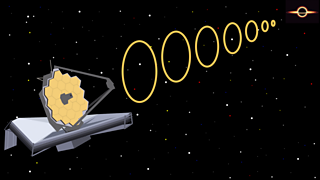
There are lots of waves all around us in everyday life.
There are waves in our seas and oceans. You can drop a rock into a pond and see waves form in the water.
Sound is a type of wave that moves through matter and then vibrates our eardrums so that we can hear.
Light is a special kind of wave that is made up of photons.
We even use waves (microwaves) to cook our food really fast.

In space, we can find lots of different types of waves.
These waves carry information about space objects, like how far away they are, how fast they're moving and what they're made of.
By studying these waves, scientists and astronomers are uncovering mysteries about the Universe.
So, what kind of waves do we find in space?
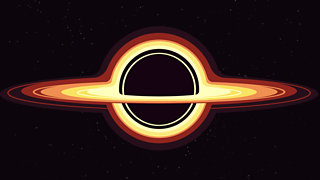
Sound waves need a medium to travel through. This is because they vibrate the particles to pass on the energy.
In space, there are virtually no particles to vibrate so sound waves can't travel in space.
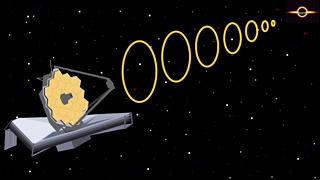
However, scientists can turn the waves we receive from space into sounds that we can hear such as star's heartbeat or the rumble of a black hole.
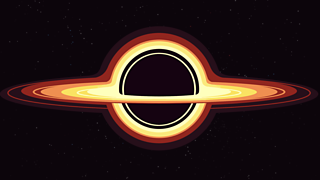
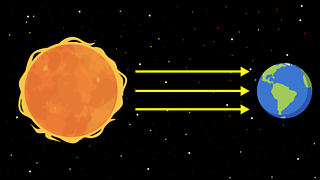
Although sound waves can’t travel in space, light waves can. That’s why everything we know about the Universe comes from light.
Light travels at an amazing 186, 282 miles per second. It can go seven-and-a-half times around the world in one second. Even at this speed, it takes light over 100,000 years to travel across our galaxy alone. The entire Universe is so big that many stars are already dead by the time their light reaches us.
Scientists have discovered that each star has its own unique light reading. Even though we could never visit them, we can use their light to study them. Written in the starlight is information about a star’s age, surface temperature and the direction it’s heading.
Astronomers have used light to reveal even more about space. They have discovered alien worlds, the age of our Universe and even the forces at play around a black hole. In short, light is helping us unlock some of space’s greatest mysteries.
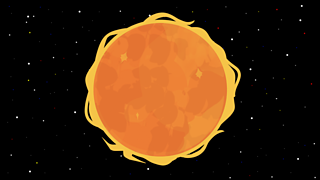
Explore the gallery below to find out about some of the most beautiful and extraordinary images of our Universe.
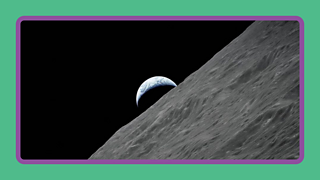
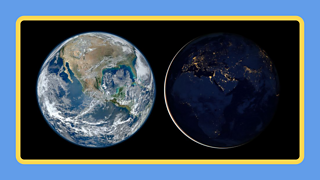
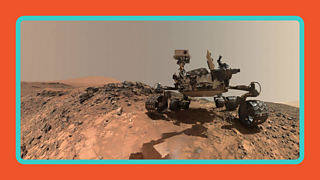
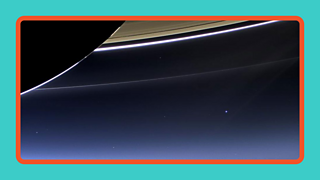
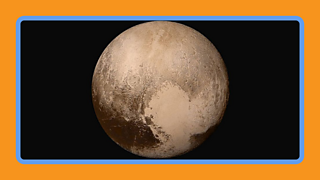
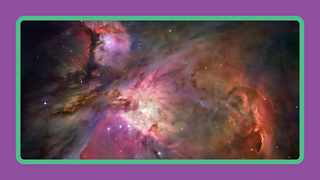
Satellites and probes offer similar benefits to telescopes.
Probes are unmanned spacecraft on a one-way ticket into space. They pick up scientific data about our Universe and beam it back to Earth.
Some probes orbit and land on different planets. Others head out into space. The probe Voyager 1 set off on its journey in 1977 and is now over 15.6 billion miles away!
Your eyes aren't powerful enough to see all the secrets of space. That’s why scientists use telescopes, satellites and probes to observe the Universe in greater detail. These instruments can also pick up light that is undetectable to our eyes.
Studying light on Earth has a few problems. The Earth’s atmosphere disturbs and blurs our pictures of the Universe. By putting telescopes into space, these problems can be solved instantly.
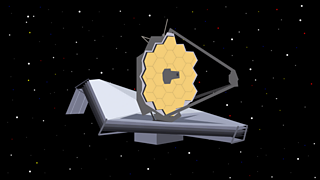
The James Webb Space Telescope launched on the 25th December, 2021 and is the largest telescope in space. Unlike the Hubble Space Telescope, it orbits the Sun (roughly 1 million miles away) not the Earth.
It can see further into the Universe than ever before, viewing supernovas, black holes and galaxies at the edge of the known Universe. It will help astronomers learn about the history of our Universe.