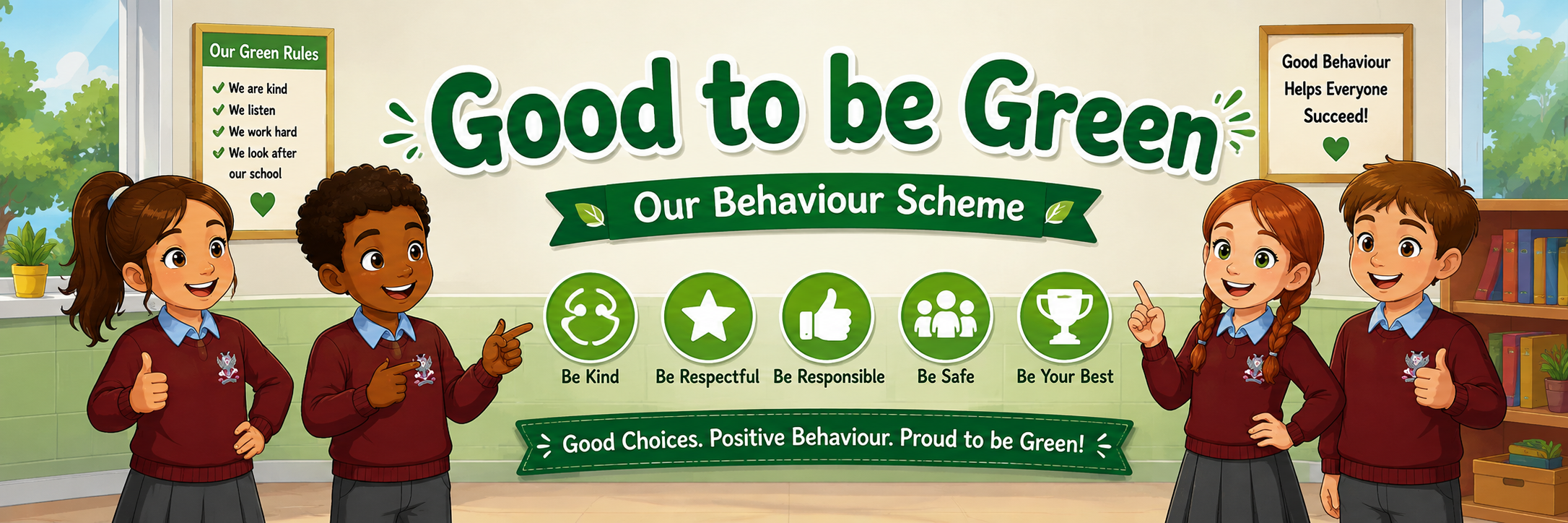
Good to be Green

We implement the “Good to be Green” code at Abercarn Primary School. It is expected that children follow three simple codes:
The Good to Be Green Code
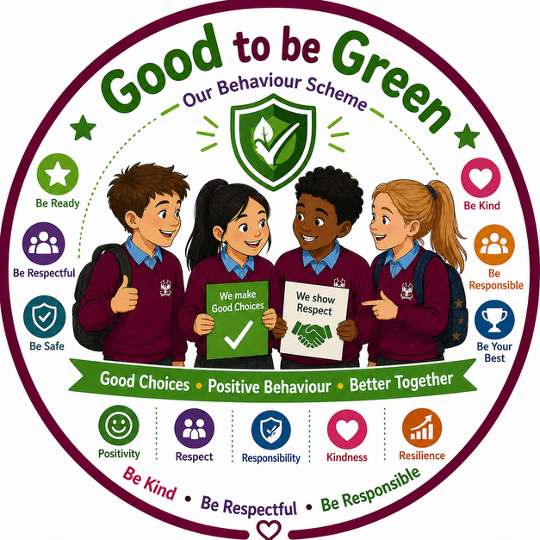
The Good to Be Green Code – 3 simple rules that must always be followed inside and outside the classroom:
Be Ready
Be Respectful
Be Safe
Our aim is always to change disruptive behaviour in a positive way, e.g. catch them being good, praise other children to highlight expected behaviour, friendly reminders, moving children to a space where they would be more focused, asking them to be a “helper”, etc. The wall chart will be in a prominent position so any adult entering the room can praise the children on green and support any child who may need help getting back to “green" positive reinforcement. It is important to recognise the school may need external support with implementing specific behaviour strategies. parental support will be sought.
The Cards
Every child has 3 cards behind their name which are used alongside positive reinforcement of the ‘Good to Be Green Code’.
Green Card
The majority of children will have a green card displayed by their name. This is because they have been following the code / rules consistently. It is important to reinforce the good behaviour of these children, reward them with pupil reward points, stickers, privileges and notes home etc
Yellow Card
- Occasionally children will need a reminder of behaviour expectations in school.
- A verbal warning will e given: “You need to think about your behaviour and make different choices”. If a warning is given the phrase “Our rules, your behaviour, you’re better than that” will be said.
- If you say the phrase twice – that equates to two warnings
- If a child receives two warnings, they will be asked to sit closer to the adult and will be asked to reflect on the choices made and improve their behaviour. A timer may be used.
- Before returning to their desk, the teacher will have a brief discussion with the child to ensure the child has strategies to make the right choices.
- However, if the disruptive behaviour continues despite the warning and reflection time, the child will receive a yellow warning card.
- A yellow card is a visual WARNING where the staff member who dealt with the incident explains to the child that they need to change their behaviour and earn their way back to green. Examples of how they can earn their way back to green will be discussed with the child.
- A yellow card means the child will miss 5-10mins of their playtime (not all of the break) to reflect on the expected behaviour for learning at our school. This will involve spending time with the designated break time adult. The child will also move within class to complete their work.
Red Card
- If a child continues to not follow the code, they will be requested to change their card to red and (if required) leave the classroom for a morning or afternoon session to complete tasks in another classroom.
Progression Step 1 and 2 children will go to Mrs Parry
Progression Step 2 and 3 Children will go to Mrs Tavas
- Restorative justice discussion must take place with the class teacher at break time and outline “how” the child can get back to “green”.
- There will be occasions where a child’s behaviour will take them straight to red e.g. total disregard for the code, physical fighting, verbal abuse, bullying, damage to property, stealing etc,
- Once a child receives a red card they will miss their playtimes and lose privileges for a set period of time - This will include losing playtimes for 2.5 days (R/Y1) 5 days (Y2 onwards). Younger children will walk with an adult outside. Children will be expected to take this consequence and only return to yellow / green if they work hard to change their behaviour and undertake the consequence for 5 days e.g. if red card issued on a Friday – children will not automatically return to green on the following Monday. Flexibility regarding receiving the consequence following absence from school during the consequence.
- The Headteacher should be notified and record the incident. The Headteacher will also encourage the child to make the right choices.
- If a child is on a red card, they will spend their time with the designated supervisor at break times. All playtimes will always be supervised.
- Class teachers must inform parents that a red card has been issued and consequences given.
- The child will need to earn their way back to green moving through yellow and then to green. This will be discussed at break time supervision.
- If a child receives a red card more than once in a half term period, parents will be asked to attend school, meet with the class teacher and discuss strategies for improving behaviour, further consequences and next steps
Rewarding Good Behaviour
We want to recognise the majority of children who are consistently following the ‘Good to Be Green Code’. There are lots of ways in which this will happen:
- Pupil reward points
- Verbal Praise and encouragement
- Notes / Postcards home
- House Points
- Good to be Green Prizes at discretion of class teacher.
- Privileges
What will happen at Lunchtimes?
- Lunchtime supervisors can reward good behaviour by allocating pupil reward points.
- Lunchtime supervisors must use incident / behaviour sheets as normal but give the children a verbal warning “You need to think about your behaviour and make different choices” before writing their name on the sheet.
- Children to be reminded that if their name appears on the behaviour sheet they will have a yellow warning card on their return to class. It is the responsibility of the midday supervisor to inform class teachers.
- If a yellow card is given and children will need to earn their way back to green during the afternoon. This will be recorded on the lunchtime sheets.
- Regular misbehaviour at lunch will involve a lunchtime consequence. For severe misbehaviour at lunchtime, children will be sent to the designated supervisor and this will be discussed at staff meetings so all staff are aware. Red cards at lunchtime can only be issued by the Class teacher.
Break times
- Incidents at break time should be wherever possible be dealt with by the teacher on duty. Squabbles / arguments must be settled at the time.
- Misbehaving at break time should be dealt with on the yard and appropriate warnings provided as in the class situation.
- If children are warned and behaviour does not improve a consequence card can be given and the class teacher informed by the teacher on duty.
- For serious breaches of behaviour, a red card can be issued and the appropriate consequences issued for red card behaviour (as above).