Text size
Line height
Text spacing
Inset Day - Tuesday 1st September 2026, School will be closed to all pupils..
Autumn Term commences on Wednesday 2nd September 2026 for all pupils...
Updated Dinner Menus - Click here to view the updated menus
The Earth is always spinning on an imaginary line called an axis. This line goes through the North and South poles.
We call this spinning, rotation, and it takes about 24 hours for the Earth to make one full turn.
As the Earth rotates on its axis, it is also orbiting the Sun. As it rotates on its axis, different parts of the Earth face the Sun, which does not move.
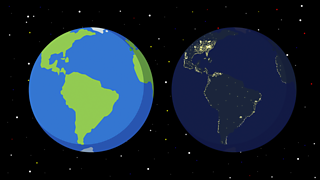
When a part of the Earth is facing the Sun, it's daytime and you can see the Sun in the sky. As the Earth keeps spinning, that same part of the Earth starts to turn away from the Sun and it begins to get dark. This is called night-time.
You may have noticed that during the summer, the day is longer than the night and during the winter, the day is shorter than the night. This is because the Earth's axis is actually tilted.
This is what causes the Earth to have seasons.
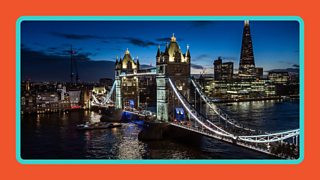
The clocks go forward to British Summer Time (BST) on the last Sunday in March every year, meaning we all lose an hour of our day.
They go backward on the last Sunday of October every year, which is when we gain an hour!

Do you ever look up at the sky and see that the Sun has moved? You may even have heard the phrase:

This is not true!
The Sun doesn't actually move across the sky. The sun stays exactly where it is: in the centre of our Solar System.
The sun appears to move because the Earth is rotating.
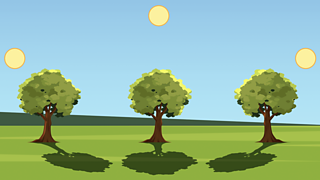
In the morning, it looks like that the Sun is rising in the east. As the day goes on, the Earth continues to spin. The Sun appears to move higher in the sky.
Later, as the Earth starts to turn away from the Sun, it looks like that the Sun is setting in the west.
It is the spinning of Earth on its axis that causes day and night.
It is this spinning that also makes the Sun look likes it's moving across the sky when actually it is the Earth that is moving.
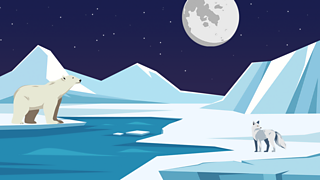
Longyearbyen in Svalbard, Norway is the world's most northerly civilian settlement.
Every year from around November 14th to January 29th Svalbard experiences a Polar Night of complete darkness without any sunlight.
In summertime Svalbard experiences a Midnight Sun between the months of April to August, when the Sun never sets!