Text size
Line height
Text spacing
Inset Day - Tuesday 1st September 2026, School will be closed to all pupils..
Autumn Term commences on Wednesday 2nd September 2026 for all pupils...
Updated Dinner Menus - Click here to view the updated menus
The world wide web is used to share information between different devices connected to the internet.
It was created in 1989 by Sir Tim Berners-Lee who was working at the CERN laboratories in Switzerland.
He was looking for a way to share information between different computers connected to the internet.


Sir Tim Berners-Lee wrote the original proposal for the world wide web.
He wrote about the technologies needed to make the world wide web work.
His proposal included the three main technologies (HTML, URL and HTTP) that were needed and which remain in use in today.

The first website went live at CERN in Europe.
Sir Tim Berners-Lee created the first-ever website. It was hosted by CERN in Switzerland, the research centre he worked at.

The first web server outside of Europe was set up at Stanford University in the USA.
All the early web servers had been set up in Europe, this was the first in America. There were only 10 known web servers around the world in 1992.

CERN allowed anyone to use the web protocols and code for free.
The technologies that had been developed to make the world wide web became 'open source' so that anyone could use them for free.
People started to create websites for personal and online businesses. The number of known web servers increased to 50 during 1993.

Telecommunications companies started to provide internet access.
Access to the world wide web started to become available in people's homes. The number of web servers increased to 623.
In 1994 the World Wide Web Consortium (W3C) was founded by Sir Tim Berners-Lee. The W3C is the organisation that makes sure that the world wide web continues to develop.
Sir Tim Berners-Lee developed three new protocols to make sure that all computers connected to the internet could use the web.

HTML was useful because it meant that people could make additions (markup) to the documents they had already created.
The first version of HTML only contained 16 commands because most webpages only contained text.
Today, HTML (HTML 5) allows webpages to have a mixture of media such as video, sound files, images and text.
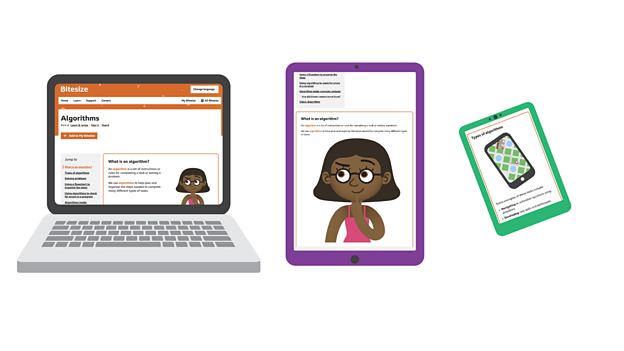
We can use a variety of devices to view webpages. HTML can now be used to detect the size of your screen and change the layout to suit it.
Try having a look at this page on a computer or laptop screen, a tablet and a smartphone. Can you notice the difference in the layout?
Have you ever searched for a product and then seen an advert for it on a webpage a few days later?
This is because search engines use your searches to select adverts that it thinks will interest you.
When different people view the same webpage on different devices, they may see different adverts.
Many businesses use the web to promote their products. They have webpages that you can visit to find out more about their products.
These pages will have hyperlinks to online stores where you can buy their products. They will also place adverts for their products on other webpages.
In the future, the internet of things will become even more automated.
This means tasks will be completed without any human input.
There are many predictions for how the world wide web might develop in the future. Thereis no guarantee that all these predictions will come true. But one thing is certain, the world wide webis here to stay.