Text size
Line height
Text spacing
Our FREE toddler sessions are every Thursday at 2pm in our school Nursery. These are free sessions for pre nursery children. Please give us a call to let us know you will be coming.
Find out your child’s House/Sports day team.Click here.
Inset Days - Monday 22nd & Tuesday 23rd June 2026, School will be closed to all pupils..
Have you ever wondered how a rocket launches into space?
How can a heavy object full of astronauts actually get off of the ground?
Well the answer is combustion!
Have you ever blown up a balloon and let it go – the air rushes out and makes the balloon fly away. This is similar to what happens when a rocket launches.
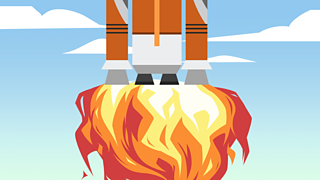
Rockets are propelled up into the sky by a chemical reaction known as combustion. This is a process where fuel reacts with oxygen, releasing heat and producing hot gases.
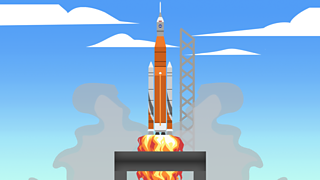
Rockets are powered by burning fuel, which makes hot gases shoot out of the base of the rocket, and this pushes the rocket upwards and away from the Earth.
Step 1
Rocket fuel is mixed with oxygen and ignited. This starts a chemical reaction.
Step 2
This chemical reaction produces a large amount of heat and hot gases.
Step 3
The hot gases are forced through a nozzle, expanding rapidly and accelerating. This expansion generates thrust. The faster and hotter the gases, the greater the thrust.
Gravity, a pulling force, is trying to keep the rocket on the ground. There has to be enough thrust from the rocket's engines to overcome gravity.
Just before dawn on the icy plains of Central Asia, a giant hanger door opens and a train towing a 2,000 tonne Soyuz rocket rolls to the launch pad in the morning light.
On launch day, three astronauts pack into the capsule on top of the rocket and make the journey to the International Space Station (ISS). After lift-off, the rocket quickly burns through its fuel. Once the tanks are empty, they break away and fall back to Earth, while the rest of the rocket continues on to the ISS.
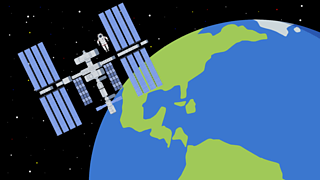
When the astronauts reach the ISS, it’ll be their home for around the next six months. The space station is a kind of orbiting science lab about 250 miles above the earth.
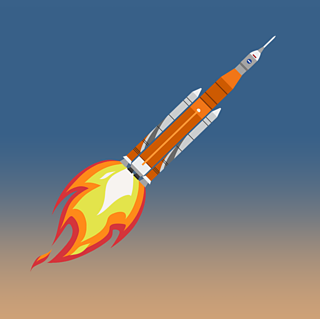
Astronauts spend years training for the launch day. Every action is carefully controlled and prepared for, right down to the tiniest detail.
Nothing is left to chance. The astronauts are strapped in to a Soyuz rocket charged with highly explosive fuel - one minor miscalculation could be disastrous.
It can take less than nine minutes for the astronauts to get to space. As the Soyuz bursts out of the atmosphere, the sky flashes from blue to black and the capsule is left orbiting the Earth.
But the space station isn't floating in one place – it's flying around the planet at over 17,000 miles per hour!
The astronauts have to delicately guide their capsule to meet a tiny docking station on the ISS. It’s a ballet between hundreds of billions of pounds of space technology – all done while wheeling around the world at 10 times the speed of a bullet.
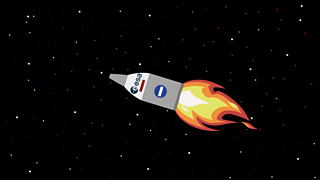
The Saturn V rocket that took NASA astronauts to the Moon in the 1960s and 1970s carried a massive 770,000 litres of kerosene fuel and 1.2 million litres of liquid oxygen.
That's how much thrust and combustion it took to escape Earth's orbit!