Text size
Line height
Text spacing
We're currently redeveloping our website so you may see a mix of old and new style pages and forms while we complete this work..
Inset Day - Tuesday 1st September 2026, School will be closed to all pupils..
Autumn Term commences on Wednesday 2nd September 2026 for all pupils...
The four planets that are furthest from the Sun are known as the gas planets.
They are named this because they are all made from gas.
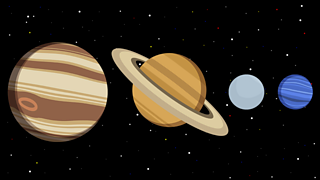
The four gas planets are Jupiter, Saturn, Uranus and Neptune.
You could not stand on their surface as they are not solid. They are giant balls of hydrogen, helium and other gases.
The four gas planets are much larger than the rocky planets, and each one has many moons that orbit it.
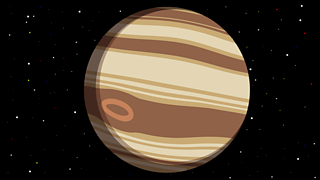
Jupiter is the fifth planet from the Sun and is the largest planet in our Solar System.
It has a diameter that measures a whopping 89,000 miles!
It is so big that it is sometimes called a gas giant.
Jupiter has big storms across the planet. The most famous is called 'the red spot' which has been swirling around on Jupiter for at least 300 years.
Jupiter rotates quickly on its axis and one day goes by in just 10 Earth hours. However, because it is further away from the Sun, a year on Jupiter is over 11 Earth years.
There are currently 95 recognised moons orbiting Jupiter, and thousands of other small objects in its orbit.
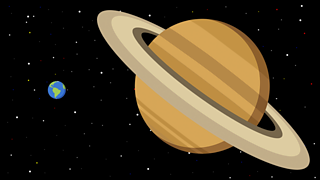
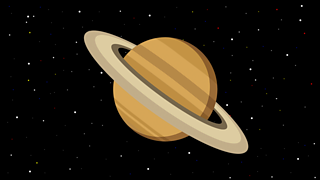
Saturn is the sixth planet from the Sun and is most famous for its rings. There are seven rings surrounding Saturn. These rings are made of chunks of ice and rock.
Saturn is another gas giant measuring 75,000 miles in diameter.
Like Jupiter, Saturn rotates on its axis quickly and one day on Saturn goes by in just over 10 Earth hours. However, because of its distance from the Sun, one year on Saturn is the same as 29 Earth years.
Saturn currently has 146 recognised moons.
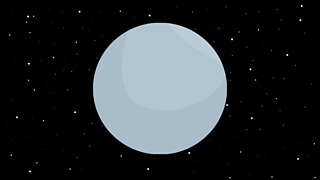
Uranus is the seventh planet from the Sun. It has a rocky centre and the surface is made up of a dense fluid of "icy" materials, mainly water, methane and ammonia. Because of this, Uranus is referred to as an ice giant.
It is blue in colour because of the methane gas in its atmosphere.
It has a diameter of 32,000 miles.
Uranus is surrounded by 11 rings.
Uranus is the only planet that rotates on its side. This is thought to be because it was hit by a large object a long time ago.
Like the other gas planets, Uranus rotates quickly on its axis and a day on Uranus lasts just over 17 Earth hours. As it is so far away from the Sun, it takes 84 Earth years to complete one full rotation.
It has 28 known moons.
Neptune is the furthest planet from the Sun. It is very similar in size to Uranus and has a diameter of 31,000 miles.
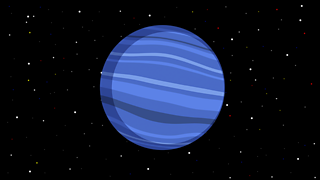
Like Uranus, it is an ice giant with a thick cloud of water, ammonia and methane surrounding a solid centre. It is cold, dark and extremely windy.
The methane in the atmosphere gives it the same blue colour as Uranus.
There are five rings around Neptune but they are difficult to see through a telescope.
Neptune spins on its axis quickly and one day on this planet is 16 Earth hours. However, as Neptune has such a distance to orbit around the Sun, it takes 165 Earth years to travel around it once.
Currently scientists believe that Neptune has 16 moons.
Jupiter doesn’t have a surface, as it's made up of a mix of gases and liquids.
This means that we couldn't land humans or a rover on Jupiter, but even flying through it's atmosphere would be dangerous as the extreme pressures and temperatures deep inside the planet would crush and burn anything going through it.