Text size
Line height
Text spacing
We're currently redeveloping our website so you may see a mix of old and new style pages and forms while we complete this work..
Inset Day - Tuesday 1st September 2026, School will be closed to all pupils..
Autumn Term commences on Wednesday 2nd September 2026 for all pupils...
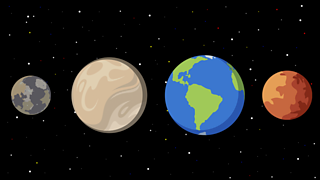
The four planets that are closest to the Sun are known as the rocky planets. They are called this because they are all made from rock, yet each one is unique.
The four rocky planets are - Mercury, Venus, Earth and Mars.
The rocky planets all have a hard surface, which contains metals such as iron.
They are the smaller of the eight planets in our Solar System and rotate on their axis at a slower pace than the gas planets, meaning their days are longer.
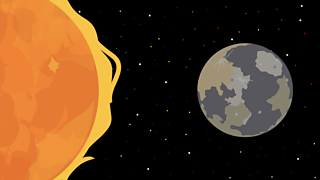
Mercury is the closest planet to the Sun. It has a solid surface which is covered in craters and is the smallest planet in our Solar System measuring approximately 3,032 miles in diameter. This is just a little bit bigger than Earth's moon.
It experiences extreme temperatures. During the day, temperatures can reach more than a scorching 400°C but can drop to nearly -200°C at night.
Mercury rotates on its axis slower than many of the other planets. It takes 59 Earth days to make one day or one full rotation on Mercury.
However, because Mercury is closest to the Sun, a year on this planet goes by fast. It completes one revolution around the Sun in just 88 Earth days.
Unlike Earth, Mercury has no moons.
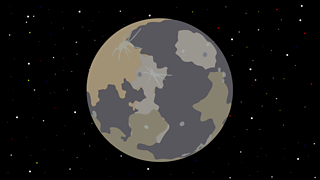
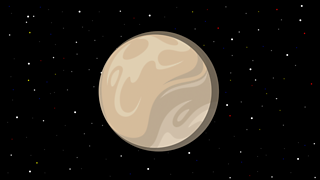
Venus is the hottest of all the planets, despite being the second closest to the Sun.
This is because it has a thick atmosphere of carbon dioxide and sulphuric acid which traps the heat in like a blanket. This makes the planet so hot that it can even melt some metals.
Venus is a similar size to Earth with a diameter of approximately 24,000 miles.
The surface consists of mountains and volcanoes.
The rotation of Venus is very slow. It takes about 243 Earth days for it to spin around once on its axis. Like Mercury, Venus has a very short year as it is close to the Sun. A year (a full rotation of the Sun) on Venus goes by in 225 Earth days. This means that a day on Venus is actually longer than a year on Venus.
Just like Mercury, Venus doesn't have any moons.
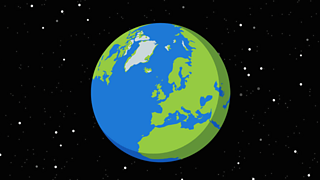
Earth, our home, is the third planet from the Sun. It is an active planet with mountains, valleys, volcanoes, plains, deserts and more.
Water covers 70% of the Earth's surface.
Earth is a similar size to Venus with a diameter of approximately 7,500 miles.
The atmosphere on Earth is made of nitrogen and oxygen which we need to breathe. The atmosphere also protects us from meteors as these break up when entering our atmosphere. Our atmosphere also keeps the planet warm enough to support living things. Earth is the only planet in the Solar System that is known to support life.
A day on Earth lasts 24 hours.
As Earth is close to the Sun, the rotation is much quicker than those planets further away. A year on Earth lasts 365 and a quarter days. However, having a quarter of a day every year would be strange, so instead every four years, we add an extra day, which we call a leap year. A leap year is 366 days and means that February has 29 days.
It is the only planet with just one moon.
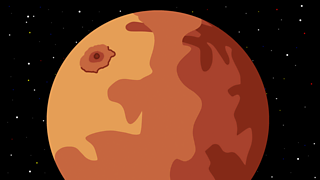
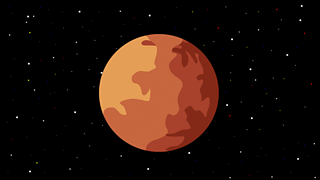
Mars, known as the 'Red Planet' because of its dusty red appearance, caused by iron in the ground. It is the fourth planet from the Sun.
Mars has a much colder average temperature than Earth, which can be as low as -153 degrees celsius.
It is half the size of the Earth with a diameter of approximately 4,200 miles.
Just like Earth, Mars has seasons, volcanoes and polar ice caps. However, unlike Earth, people could not live on Mars. This is because we could not breathe the air. Despite this, scientists are using robotic vehicles to examine the surface of Mars to see whether it could support life.
Mars rotates on its axis at a similar speed to Earth. One day on Mars lasts just over 24 hours. However, a year on Mars is almost double the length of an Earth year, 687 Earth days. This is because it is further from the Sun so it takes longer to rotate around it.
Mars has two moons, Phobos and Deimos.
Mars has the largest volcano in the Solar System, Olympus Mons which is 14 miles high.
This is over three times higher than Everest, Earth's highest mountain.