Text size
Line height
Text spacing
Inset Day - Tuesday 1st September 2026, School will be closed to all pupils..
Autumn Term commences on Wednesday 2nd September 2026 for all pupils...
Updated Dinner Menus - Click here to view the updated menus
Natural disasters are powerful events that happen in nature. They can be storms, earthquakes, floods, or even volcano eruptions! Some can happen suddenly, while others take time to build up.
Let’s learn about different types of natural disasters and how they affect the world! 🌏
A natural disaster is when nature causes serious damage to people, homes, and the environment. These disasters can:
✔ Happen quickly or slowly
✔ Change the land (like earthquakes or volcanoes)
✔ Be dangerous for people, animals, and buildings
✔ Happen anywhere in the world

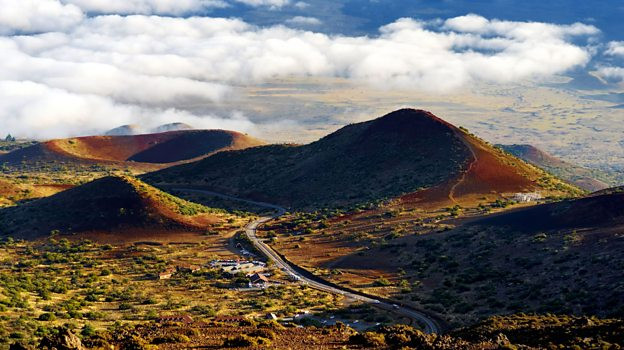
Volcanoes can look like small mountains or hills.
A volcano is an opening in the Earth's crust that allows magma, hot ash and gases to escape.
There are two main types of volcano:
Composite volcanoes are the most common type of volcano. They can have violent eruptions and can grow bigger as layers of thick lava and ash harden on top of each other. Mount Etna in Sicily, Italy, is an example of a composite volcano.
Shield volcanoes do not have such violent eruptions. These volcanoes tend to have gentle slopes and their runnier lava spreads and hardens over a wider area. Mauna Loa in Hawaii is an example of a shield volcano.
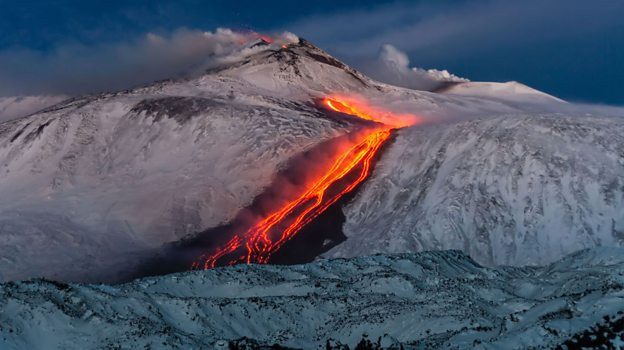
Most volcanic eruptions are caused by pieces of the Earth's crust, called tectonic plates, moving towards each other.
Some volcanoes, like Mauna Loa in Hawaii are caused by hot spots in the Earth’s crust. These do not erupt violently and lava usually flows slowly out of them.
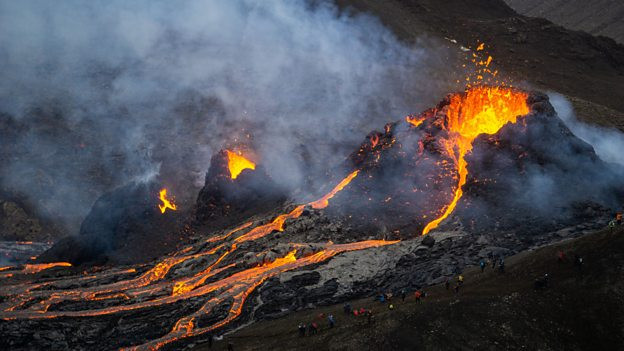
Eruptions from volcanoes can be very dangerous. They can produce:
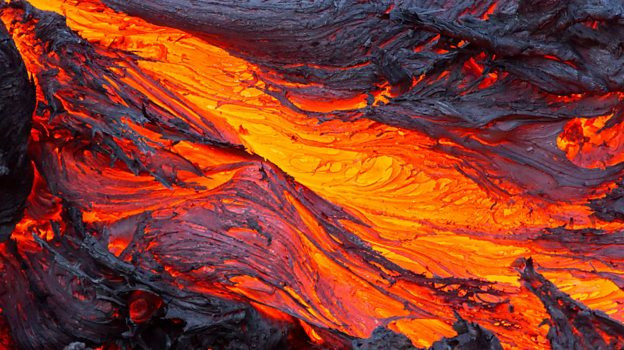
Magma, a mixture of hot, molten rock and gas, builds up deep beneath the surface of the Earth under enormous pressure. The magma rises, looking for weaknesses through rocks in the Earth’s crust.
Volcanoes are usually found along the boundaries of tectonic plates.
When magma erupts from a volcano it is called lava. This mixture of lava and gas flows out and down the sides of a volcano, some may cool and erupt as ash.
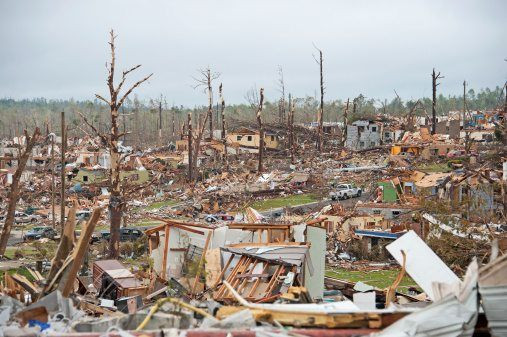
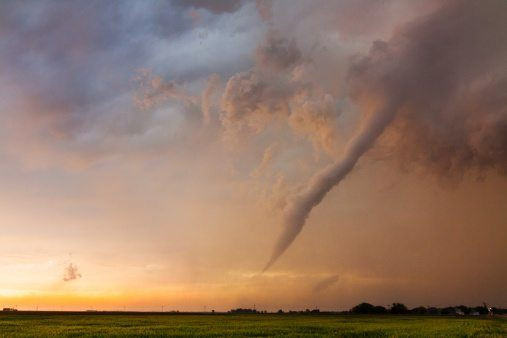
A tornado is a column of strongly rotating winds that develops within a cloud and makes contact with the ground. Tornadoes, or twisters as they are sometimes called, occur most often during spring and summer thunderstorms. They can generate the strongest winds known on Earth. Wind speeds in the range of 300 miles (500 kilometers) per hour have been measured in extreme events. Winds of this magnitude can cause enormous destruction and great loss of life. Injuries often occur from flying debris and collapsing structures. Most tornadoes, however, are relatively weak events that occur in sparsely populated areas and cause minor damage. For additional information and media, see the articles storm and weather.
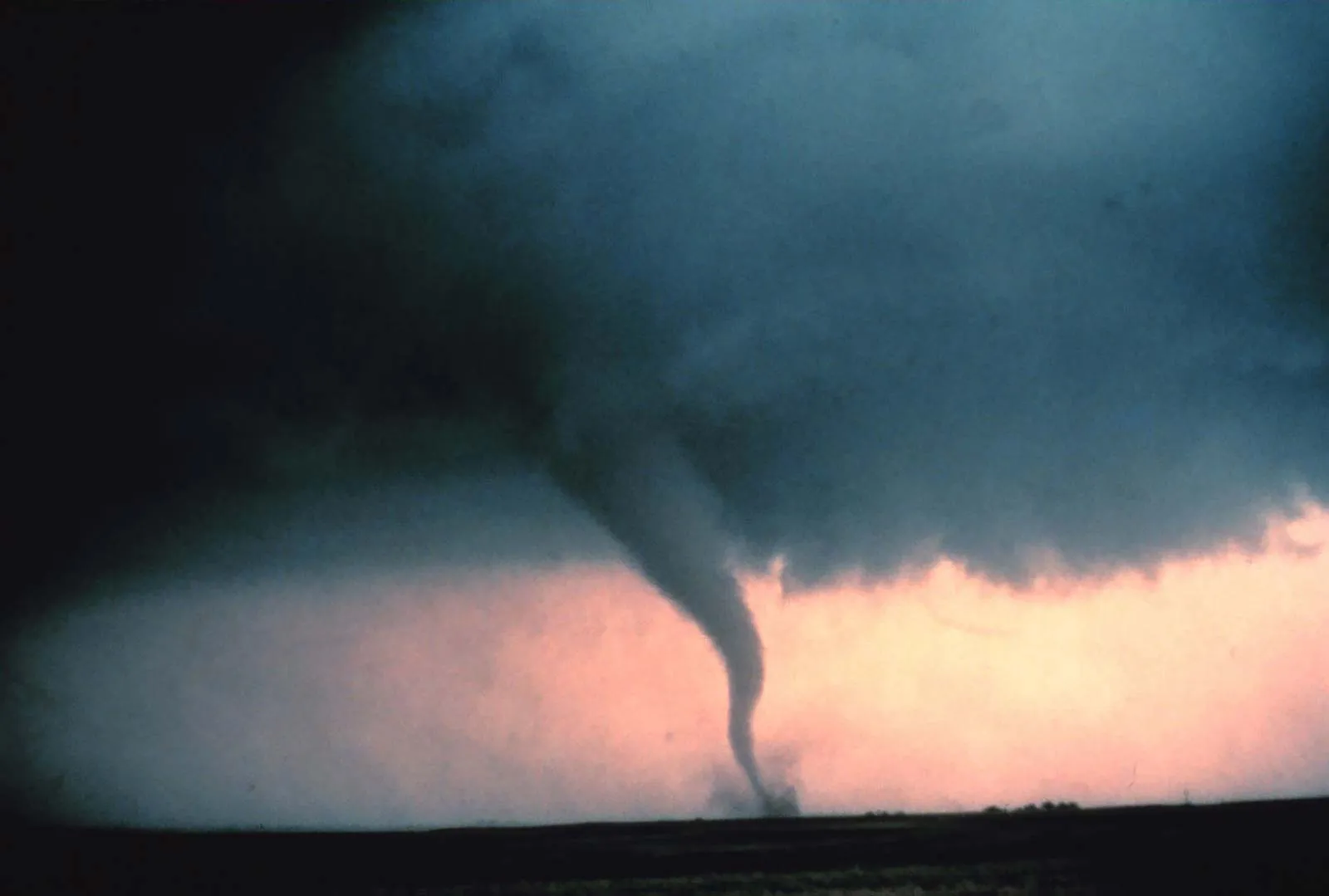
Tornadoes may occur wherever conditions favor the development of strong thunderstorms. Such storms usually begin when cool, dry air moves over a layer of moist, warm air near Earth’s surface. The atmosphere becomes unstable from the collision of air of different temperatures and moisture levels. As the warm air rises, the huge clouds commonly associated with thunderstorms and tornadoes form.
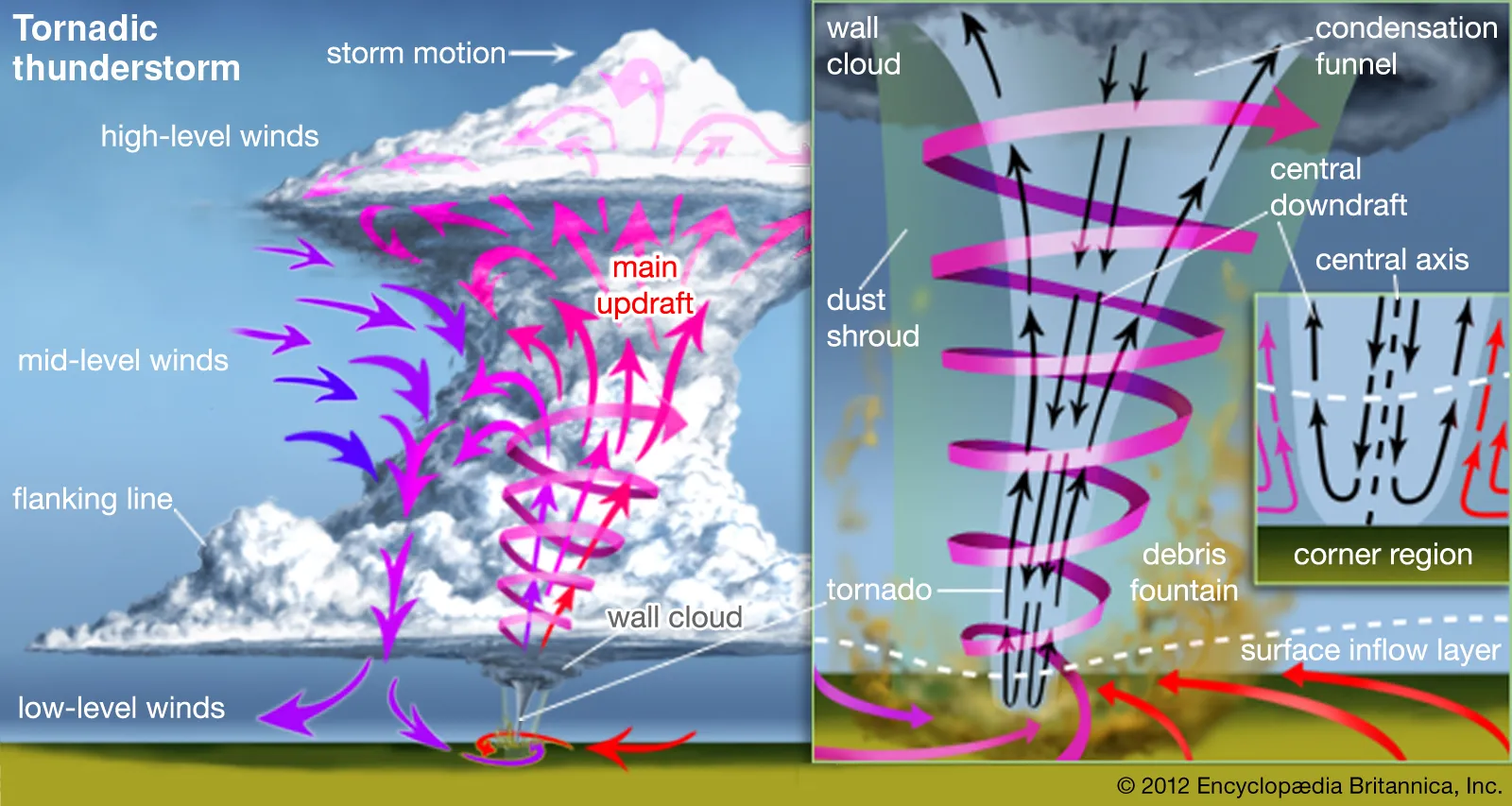
Most tornadoes form when a strong updraft (an upward current of air) spins into a swirling column of air. An increase in wind speed and a change in wind direction cause the updraft to shift from horizontal to vertical. The resulting swirling column of rising air is called a mesocyclone. It is perhaps 6 to 12 miles (10 to 20 kilometers) in diameter. Inflowing warm air at the lower end of the updraft causes air to be accelerated upward and vertically “stretched.” Vertical stretching normally causes the mesocyclone to shrink to a diameter of about 1 to 4 miles (2 to 6 kilometers). As this happens, the mesocyclone rotates more quickly, which in turn strengthens the winds entering at its base. In this manner, the mesocyclone grows in strength.
he swirling core can reach Earth’s surface—in other words, a tornado can form—once the mesocyclone is established. Most mesocyclones do not generate tornadoes. In the ones that do, a small region of increased inflow of air and stretching develops in the mesocyclone. Storm researchers are not sure why this sometimes happens. Enhanced spin begins several miles above the ground, then quickly builds downward. Rotation is strong enough for a tornado core to form and extend to within several tens of miles of the surface.
As the core approaches the ground, surface friction slows the rotational motion. Surface friction also limits the rate of airflow into the base of the core. At the same time, the parent storm’s strong updraft prevents sufficient air from filling the core from above. The air pressure in the core is thus lower than the pressure outside the core at the same elevation. Subsequently, a condensation funnel (funnel cloud) forms that may reach the ground.
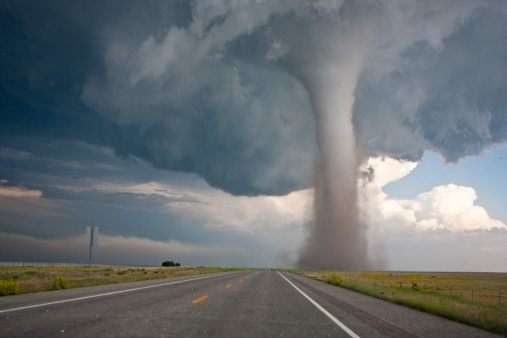
1) Tornadoes – also known as “twisters” – are violently rotating columns of air that reach from a storm cloud to the earth’s surface.
2) The winds of a tornado can reach speeds of up to 480km per hour – that’s strong enough to peel the roofs off houses, uproot trees and hurl heavy objects, such as cars, hundreds of metres!
3) Tornadoes come in different shapes and sizes. Some may appear as wide funnel-shaped clouds, others as thin rope-like swirls stretching from the ground to the sky.
4) The duration of tornadoes, and the distance they travel, varies. Most last less than ten minutes and travel five to ten kilometres before disappearing. In extreme cases, however, they can last several hours and cross distances over 150km!
5) Tornadoes are measured using the Fujita Scale (or F-scale), ranging from F0 to F5, with F5 being the strongest and most destructive.
6) The deadliest tornado ever recorded was in Bangladesh in 1989. As it travelled through the Dhaka region of the country, more than 20 villages were destroyed and around 1,300 people were killed.
7) Most of the world’s tornadoes occur in the United States in what’s known as Tornado Alley. Stretching from west Texas to North Dakota, this area can see more than 200 tornadoes each year!
8) If a tornado occurs over water, it’s called a waterspout.
9) Not all tornadoes are easy to see. In fact, they can be invisible until they pick up dust and debris, or a cloud forms within the spinning funnel.
10) The formation of a tornado is so complex that scientists still don’t completely understand it. And what’s more, the unpredictability of tornadoes makes them difficult – and dangerous – to study. A tornado will demolish everything in its path, including measuring equipment. And so, the secrets behind this incredible force of nature are yet to be discovered…
The wind at the beach is whipping at 95 miles an hour. Waves 16 feet tall are crashing down. Even sharks are heading out to calmer waters. A hurricane is on its way.
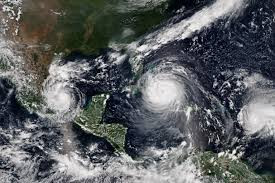
These powerful storms have different names depending on where in the world they form. They’re called hurricanes if they occur in the Atlantic Ocean, Caribbean Sea, Gulf of Mexico, and eastern Pacific Ocean. In the western Pacific Ocean, they’re known as typhoons; in the southern Pacific and Indian Oceans, they’re called cyclones.
Scientists know them all as tropical cyclones. As many as 150 occur around the world each year.
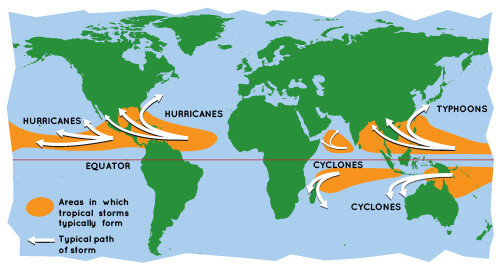
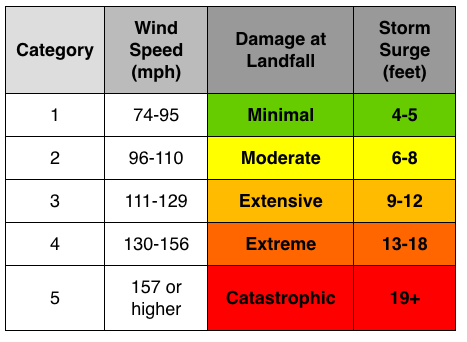
Hurricanes are strong storms that start in the ocean and have winds of at least 74 miles an hour. In the Northern Hemisphere (the part of Earth north of the equator), hurricanes generally occur between mid-August to late October. In the Southern Hemisphere (the area south of the equator), storm season is between April and December, with peak storm activity around May and November. During these times, oceans have warmer water, which is what a hurricane needs to form.
Hurricanes begin when a tropical depression forms in the ocean. A tropical depression is a line of rain showers and weak thunderstorms that circle around an area of low air pressure. If the water is at least 79°F, a hurricane might form.
The low air pressure causes the hot, humid air from the ocean to rise in a spiral shape. As that warm air rises, it releases heat, cools down, and condenses into gusty bands of clouds and storms. The low-pressure area continues to suck up hot, moist air, and the spiral gets stronger and faster.
When winds reach 39 miles an hour, the tropical depression becomes a tropical storm. When winds reach 74 miles an hour, it’s officially a hurricane.
As a hurricane moves over cooler water or hits land, it loses the warm water that fuels it and begins to weaken. But dangerous winds can still cause damage, and storm surges—when a strong storm pushes ocean water ashore—can flood coastal areas with more than 20 feet of water. Heavy rains and floods can continue far inland.
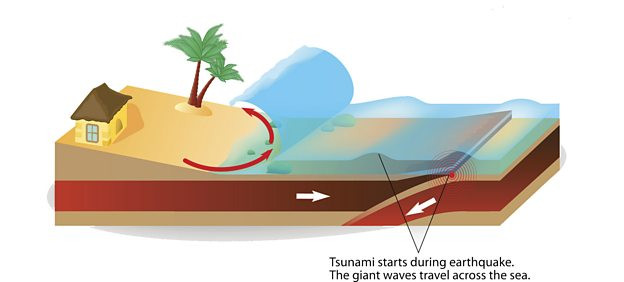
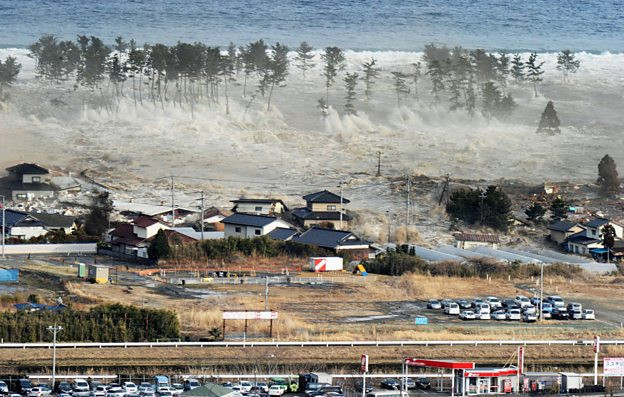
Earthquakes at sea cause water to be displaced, creating a fast-moving wave that spreads out in all directions. In the deep ocean, tsunami waves can reach speeds of up to 800 kilometres per hour. As the wave approaches shallower waters near to the shore, its speed will decrease but the waves will become higher.
These waves cause flooding and the majority of the deaths associated from tsunamis are caused by drowning. The flooding can contaminate water supplies and cause the destruction of homes.
The flooding can also lead to secondary effects such as causing illnesses in the area. These illnesses are due to poor sanitation and lack of clean water because of contaminated water supplies due to flooding. Flooding washes into clean water supplies carrying debris and sewage.
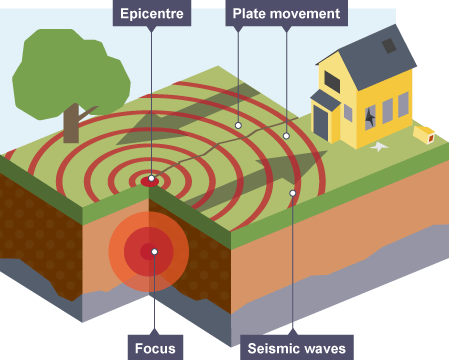
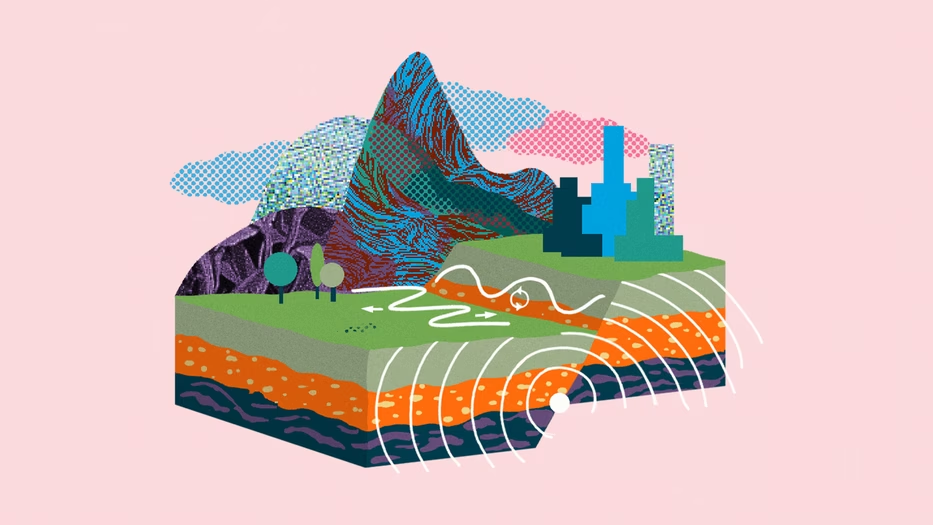
An earthquake is a sudden, violent shaking of the ground. An earthquake occurs when two tectonic plates push together. The pressure of these colliding plates builds up inside the Earth’s crust. The point in the crust where the pressure is released is called the focus. The point on the Earth's surface above the focus is called the epicentre. When the pressure is too much it is suddenly released and waves of energy, called seismic waves, occur. These seismic waves travel through the earth causing it to shake.
The shaking of the ground caused by an earthquake can cause a variety of effects. These can be classed as primary or secondary effects. Primary effects are caused by the earthquake itself, whereas the secondary effects are caused by the primary effects.
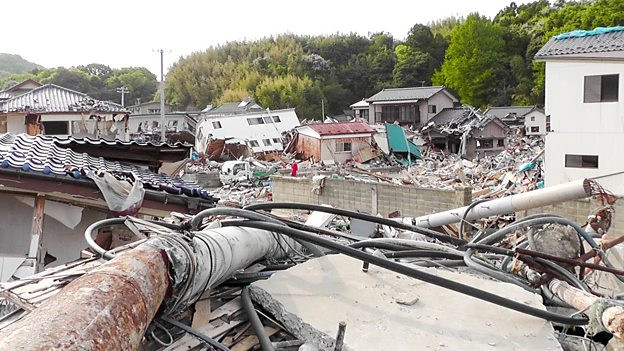
Floods happen when too much rain falls, or rivers overflow.
🌊 Water covers land, washing away cars, houses, and trees.
🚣 People sometimes use boats to move around during floods.
🌾 Farms can be ruined, making it hard to grow food.
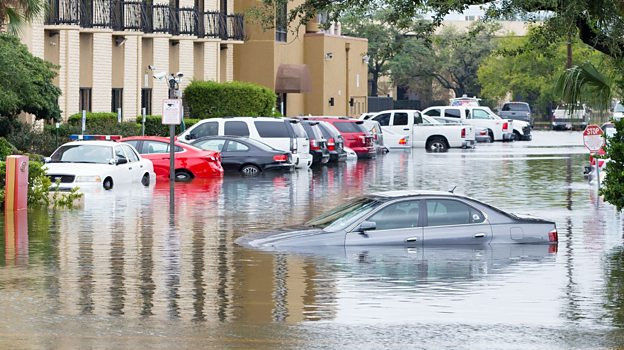
Wildfires are big fires that spread across forests, grasslands, and fields.
🔥 They can start from lightning, hot weather, or even humans.
🌲 Wildfires destroy trees, plants, and animals’ homes.
🚒 Firefighters work hard to stop wildfires from spreading!
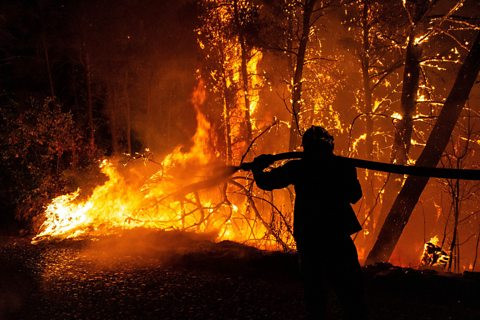
Natural disasters can change the world in many ways:
🏡 Destroying homes and buildings
🌳 Damaging the environment and wildlife
🚗 Blocking roads and cutting off power
👨⚕️ Causing injuries or making people leave their homes
But people work together to help each other and rebuild after disasters!
Although we can’t stop natural disasters, we can prepare for them!
✔ Listen to weather warnings – If a storm is coming, be ready!
✔ Have an emergency kit – Pack food, water, and a flashlight.
✔ Stay away from danger – Don’t go near floods, fires, or damaged buildings.
✔ Find a safe place – Move to higher ground during a flood or shelter during a storm.
Scientists and weather experts study natural disasters to help keep people safe.
✔ The biggest earthquake ever was in Chile in 1960! 🌍
✔ A hurricane can be as big as an entire country! 🌀
✔ The Ring of Fire is a place with lots of volcanoes and earthquakes around the Pacific Ocean! 🌋
✔ Some animals can sense earthquakes before they happen! 🐶
🎨 Draw a picture of a volcano or tornado!
📖 Write a safety plan for your home in case of a natural disaster.
🔎 Look at a world map – Can you find places where earthquakes and hurricanes happen?
Natural disasters are powerful and sometimes dangerous, but learning about them helps us stay safe and protect our planet! 🌏💙

